
World
Greece conducts controlled blast of mystery naval drone explosives
May 9, 2026 International Source: BBC World



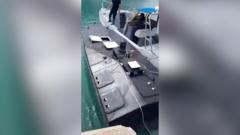
The unmanned vessel, suspected to be of Ukrainian origin, was found by fishermen in a cave on Thursday.
Greek authorities conduct controlled blast of mystery naval drone explosives
Discovered naval drone (left) is towed by a Greek coastguard boat to the port of Vasiliki
Copyright current_year BBC. All rights reserved. The BBC is not responsible for the content of external sites. Read about our approach to external linking.
Copyright current_year BBC. All rights reserved. The BBC is not responsible for the content of external sites.
Read about our approach to external linking.
A still of the drone found off Greece's coast on Thursday
Greece conducts controlled blast of mystery naval drone explosives
Moment discovered naval drone (left) is towed by a Greek coastguard boat to the port of Vasiliki
A black sea drone with an open hatch is towed by a Greek coastguard boat.
Greek authorities have rendered safe a naval drone carrying explosives after it was discovered in the Ionian Sea by fishermen.
The unmanned vessel, suspected to be of Ukrainian origin, was found in a cave near Lefkada on Greece's western coast on Thursday with its engine still running. Greek bomb disposal experts removed its detonators and battery.
The incident has raised questions about Greece's maritime security and its vulnerability to emerging military technology.
Authorities are now investigating how the drone ended up in Greece's territorial waters and why it may have been in the Mediterranean.
Ukraine has used naval drones to target Russian warships, tankers and naval bases since Moscow's full-scale invasion began in 2022, but much of this activity has been constrained to the Black Sea, which the two nations border.
Ukraine's military has so far not commented. Both Greek and Ukrainian media have identified it as likely a Ukrainian-made Magura drone.
Two reputable Greek news outlets are reporting that notes handwritten in Ukrainian were found aboard the vessel.
It was estimated to be carrying around 100kg (220lb) of explosives, prompting Greek authorities to conduct a controlled explosion in the sea near Astakos.
Specialist teams in the Greek armed forces are now inspecting the drone for clues as to its origin and purpose.
Greek newspaper Ta Nea reports that theories being considered are that the drone - with an estimated range of 432 miles (700km) - fell into the sea while being transported or was intended to target Russian shipping in the Mediterranean but lost contact with its operator.
The vessel had a built-in GPS that could have been affected by bad weather and sensors that were broken when it was discovered, according to public broadcaster ERT.
But the drone's presence has prompted criticism that Greece's Navy was ill-prepared for a new era of warfare.
"Unfortunately, all Greek women and men are realising that the country is an open vineyard," opposition defence spokesman Michalis Katrinis commented.
Meanwhile, Greece's Communist party said in a statement: "What business did the Ukrainian naval drone have in Greek territorial waters? What was its goal? Did the Greek government know if and in which operational plan it was part of? [...] Are other similar drones of other 'allies' also operating in Greek territorial waters?"
The nationalist pro-Russian Hellenic Solution party called it a "conscious military provocation".
Defence Minister Nikos Dendias sought to downplay the significance of the drone's discovery on Saturday, saying: "Because we know what it is and what it contains, we have nothing to envy."
He said that the Greek government was implementing policies that meant "our homeland can produce and be able to equip the Navy with the most advanced drones and anti-drone systems that currently exist".
The discovery has put Greece's national security agency, armed forces and several ministries on red alert.
Ukrainian drones have repeatedly attacked Russian tankers carrying sanctioned oil and naval installations in the Black Sea, with the intention of disrupting both Moscow's revenue stream and warfighting capability.
In March, Moscow accused Ukraine of hitting a sanctioned Russian tanker loaded with liquefied natural gas tanker with "uncrewed sea drones" in the Mediterranean between Libya and Malta.
Greece and Ukraine struck a joint co-operation deal to produce naval drones in November, granting Athens access to Ukrainian technology for its own use.
However, just a week ago, Greek newspaper Kathimerini reported that Kyiv was seeking a veto over their use in military engagements - apparently over concerns they could be used against neighbouring Turkey, with whom Greece has long-standing territorial disputes.
A black sea drone is towed by a Greek coastguard boat.
Greece examines mystery naval drone found in Ionian Sea
Greek media say the drone, which reportedly had explosives, could be either Ukrainian or linked to the Russia-Ukraine war.
Pro-Palestinian activists say 22 boats carrying aid for Gaza were illegally intercepted in international waters near the Greek island.
Five people were left with non-life-threatening injuries, according to Greece's state broadcaster ERT.
The unmanned aircraft can drop off 100 parcels a day within a 12km radius of Amazon's hub.
The tech giant says it hopes to slowly expand the service as the demand for ultra-fast deliveries grows.
After Ukraine's President Zelensky said territory had been captured using just robots and drones, what is the future of unmanned warfare?
A volunteer search team says the thermal imaging drone will be a “game changer” in tracking down missing dogs.
Wolverhampton, Perry Barr and West Bromwich will host several events this May.