
India
Raghu Rai: The photographer who showed India to itself
April 27, 2026 India Source: BBC India



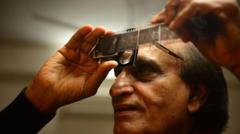
With Rai's passing, India has lost a visual historian who was a chronicler of its most defining and often painful moments.
Raghu Rai: The photographer who showed India to itself
Copyright current_year BBC. All rights reserved. The BBC is not responsible for the content of external sites. Read about our approach to external linking.
Copyright current_year BBC. All rights reserved. The BBC is not responsible for the content of external sites.
Read about our approach to external linking.
Eminent Photographer Raghu Rai, who began taking pictures that document contemporary India, on work at his Mehrauli office on January 8, 2015 in New Delhi, India. (Photo by Pradeep Gaur/Mint via Getty Images)
Remembering Raghu Rai: The photographer who showed India to itself
For more than five decades, Raghu Rai photographed the country with rare intimacy and clarity
Raghu Rai, Photographer of exhibition "In Light of India", which is part of Hong Kong International Photo Festival 2014 held at ArtisTree, Taikoo Place. (Photo by Dickson Lee/South China Morning Post via Getty Images)
Rich tributes continue to pour in for Raghu Rai, India's most celebrated photojournalist, following his death at the age of 83.
Rai spent more than five decades documenting the country, capturing moments from political power to everyday life with striking clarity.
From the aftermath of the gas tragedy in central India's Bhopal to the years of militancy in northern India's Punjab, which killed thousands in the 1980s, Rai's images shaped how India saw its most defining events.
His work did not merely record history but shaped how a nation saw it. It helped define modern Indian photojournalism, earning global recognition and influencing generations of photographers.
Raghu Rai's photo of Indira Gandhi meeting people during an election campaign in 1977
Indira Gandhi, wearing a saree and a beaded garland, in a crowd of people during an election campaign in 1977.
Rai began his career at The Statesman newspaper in 1966 and later worked as photo editor at India Today and Sunday magazines.
He joined globally recognised photography agency Magnum Photos in 1977 - often seen as one of the highest recognitions in photography - with the support of pioneering French photographer Henri Cartier-Bresson, whose work had a lasting influence on him.
Rai's photographs of former prime minister Indira Gandhi remain among the most enduring visual records of political power in India. He captured her across settings - from charged election campaigns to closed-door Congress party meetings.
Raghu Rai's photo of Indira Gandhi attending a meeting of the Congress party in 1980
A profile shot of former India PM Indira Gandhi, wearing a saree, attentively listens with her fist on her chin, at an All India Congress Committee meeting in Delhi.
Rai's photographs of celebrated figures - such as veteran playback singer Lata Mangeshkar, filmmaker Satyajit Ray, painter MF Hussain, Bollywood actor Amitabh Bachchan and others - have often captured a sense of devotion between art and audience.
Rai's work during the years of militancy in Punjab during the 1980s remains among his most striking. His portrait of Sikh separatist leader Jarnail Singh Bhindranwale captured a moment heavy with tension and consequence.
Rai often spoke about photography as something far deeper than technique.
Rai's photograph of veteran singer Lata Mangeshkar performing at an event in 1981
Bollywood playback singer Lata Mangeshkar performing at a function wearing a saree.
In one of his interviews, Rai described photography as a form of spiritual engagement with the world, saying: "I meet my god through my camera".
, Rai described photography as a form of spiritual engagement with the world, saying: "I meet my god through my camera".
"Once I pick up my camera, I am driven by the ever-changing energy of life and nature," he said. "When you have invested mentally, physically, and spiritually in situations and take pictures constantly, it is like investing in a bank of life in which the returns keep getting bigger and the energy keeps you going."
Rai also spoke about the discipline behind an image - what he described as a kind of sustained practice, rather than quick visual experiments.
Rai's photo of Indira Gandhi visiting UK Prime Minister Margaret Thatcher in London
A photograph by Raghu Rai that shows Indira Gandhi visits Prime Minister Margaret Thatcher in London, England. Both of them are wearing warm coats and can be seen surrounded by security personnel.
In the interview, Rai said his favourite portrait subject was the Dalai Lama, describing the "intensity and spiritual energy" he brings to a frame.
But he stressed that admiration should not shape the image. A portrait, he said, must reflect "the moment, the experience of the person, the energy of the person" as it existed at that time.
Rai's portrait of Sikh separatist leader Jarnail Singh Bhindranwale
Sikh separatist leader Jarnail Singh Bhindranwale, wearing a turban ans surrounded by his armed supporters and guards, sitting on a cot.
A tribute in the Indian Express newspaper recalled Rai as a "tenacious, observant and deeply curious" professional who "instilled life into every photograph that he took and captured the pulse of the nation". Another in The Times of India newspaper described Rai as a "colossus of his craft".
A tribute in the Indian Express newspaper recalled Rai as a "
" professional who "instilled life into every photograph that he took and captured the pulse of the nation". Another in The Times of India newspaper described Rai as a "
Prime Minister Narendra Modi described Rai as a "creative stalwart" who "captured India's vibrancy through his lens". In a post on X, Modi said Rai's photography showed "extraordinary sensitivity, depth and diversity", and helped bring people closer to different aspects of life in India.
Photographers and editors have often described Rai's work as bridging reportage and art, combining immediacy with composition.
His archive now stands as a sustained act of witnessing - a country, its people, and its contradictions - through a lens that remained, above all, deeply human.
Follow BBC News India on Instagram, YouTube, Twitter and Facebook.
A new study reveals a decline in dragonfly and damselfly species in India's Western Ghats.
It is unclear how he reached Eswatini. China described his visit as a "stowaway-style escape farce".
Some of India's biggest producers are eyeing investments in micro-dramas, which are now hugely popular.
From celebrating football success to plenty of election chatter - it's been a busy time for Peterborough's residents.
A selection of photographs submitted to BBC Scotland News from around the country this week.
Photographer and film-maker Alan Van Wijgerden digs into his extensive archive for a new exhibition.
The astrolabe - or astronomical computer - is possibly the largest in existence and had never been exhibited before.