
World
Global forest loss slows but El Niño fires could threaten progress
April 29, 2026 International Source: BBC World



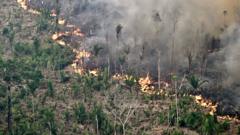
The loss of tropical rainforests eased last year, according to new analysis, but scientists warn they are still disappearing rapidly.
Global forest loss slows but El Niño fires could threaten progress
Copyright current_year BBC. All rights reserved. The BBC is not responsible for the content of external sites. Read about our approach to external linking.
Copyright current_year BBC. All rights reserved. The BBC is not responsible for the content of external sites.
Read about our approach to external linking.
The Amazon rainforest disappeared less quickly in 2025 than in 2024
Aerial view of an area of Amazon rainforest deforested by illegal fire in the municipality of Labrea, Amazonas State, Brazil on August 20, 2024.
The loss of tropical rainforests slowed last year, new satellite data suggests, largely due to Brazil's efforts to curb deforestation in the Amazon.
Researchers estimate that nearly 43,000 sq km (17,000 sq miles) of old-growth tropical forests were lost globally in 2025 – about the size of Denmark.
While it is about a third lower than record losses in 2024, scientists warn that tropical forests - among the Earth's most important ecosystems - are still disappearing much faster than a decade ago.
There is also concern that a two-pronged attack from climate change and the arrival of the warming El Niño weather pattern later this year could increase the likelihood and severity of forest fires.
The latest figures show that the loss of tropical forests fell by 36% in 2025, according to analysis from the World Resources Institute and the University of Maryland.
The data comes with a degree of uncertainty, however, as losses towards the end of one year might only be detected by satellites at the beginning of the next, but scientists are confident about the overall trend.
The decline last year partly reflects an easing of the unprecedented fires of 2024, helped by cooler La Niña conditions instead of the warmer El Niño.
The decline last year partly reflects an easing of the unprecedented fires of 2024, helped by cooler
But researchers also point to greater efforts to protect forests in countries such as Brazil, Colombia and Malaysia.
"It's incredibly encouraging to see the decline in 2025," said Elizabeth Goldman, co-director of Global Forest Watch at the World Resources Institute.
"[It] highlights how when we have political will [and] the leaders in charge who want to do something for forests, we can see real results in the data," she added.
In Brazil, home to the world's largest rainforest, researchers highlight the effects of stronger environmental policies and law enforcement in helping to slow deforestation.
Excluding losses driven by fires, an estimated 5,700 sq km (2,200 sq miles) of old-growth tropical forests disappeared in Brazil last year - the lowest figure since the analysis began in 2002.
Tropical rainforests are home to millions of species, and in a healthy state they take up vast quantities of planet-warming carbon dioxide, helping to keep the Earth cool.
They have come under increasing pressure, however, as a result of decades of deliberate land clearance for agriculture and logging, as well as climate change, which scientists warn can create the conditions for bigger fires to spread.
World leaders pledged to "halt and reverse" forest loss by 2030 at the COP26 climate summit in Glasgow in 2021, but progress towards that pledge remains way off track.
at the COP26 climate summit in Glasgow in 2021, but progress towards that pledge remains way off track.
In 2024, tropical forests disappeared faster than ever before, driven by fires amplified by human-caused climate change and the El Niño weather pattern.
In 2024, tropical forests disappeared faster than ever before, driven by fires amplified by
"Forests are well equipped to cope with normal climate," said Rod Taylor, global director for forest and nature conservation at the World Resources Institute.
"With these new intense fires and droughts and so on, we really have to think about how to make forests more resilient and proof them against climate and fire," he added.
A woman in an orange dress stands in the doorway of her flooded house on the outskirts of the city of Gonaives in Haiti. The water level is at waist height. The walls of the house are substantially damaged.
Two firefighters dressed in yellow and black protective clothing watch on as a bright orange fire blazes among some branches.
How climate change worsens heatwaves, droughts, wildfires and floods
A woman in a red and black vest top, beige shorts and sandals stands on a dried-up river bed. There is a forest in the background.
What are El Niño and La Niña, and how do they change the weather?
Researchers are concerned the threat from fires could be even higher later this year, due to a combination of climate change and a new phase of El Niño, although predictions are still uncertain.
"Climate change and land clearing have shortened the fuse on global forest fires," said Prof Matthew Hansen of the University of Maryland.
"Without urgent action to [...] manage fire more effectively, we risk pushing the world's most important forests past recovery."
In a separate report released on Wednesday, the EU's Copernicus climate service laid out how climate change had helped to drive intense heatwaves, wildfires and droughts in large parts of Europe last year.
Already the world's fastest-warming continent, few places escaped the heat, with at least 95% of Europe experiencing above-average annual temperatures.
The warmth helped to create conditions for widespread wildfires, with more than 10,000 sq km (4,000 sq miles) burning in total - a bigger area than Cyprus.
There was no escape for Europe's traditionally cold regions either, with Alpine glaciers continuing to lose ice and temperatures in the Arctic Circle reaching 30C in July.
There was no escape for Europe's traditionally cold regions either, with
temperatures in the Arctic Circle reaching 30C
The average surface temperature of Europe's seas was also the highest on record, with the Mediterranean Sea particularly badly hit.
The average surface temperature of Europe's seas was also the highest on record, with
the Mediterranean Sea particularly badly hit
The report did point to progress on efforts to tackle climate change, with nearly half of Europe's electricity now coming from wind, solar and hydropower.
Aerial shot of dense green rainforest with thick clouds of smoke rising up into the air
Tropical forests destroyed at fastest recorded rate last year
A rainforest stops where an area is cleared to make way for a soya plantation. Next to a line of trees, there is a brown open field with a single tree standing in the middle.
Brazil's Amazon rainforest at risk as key protection under threat
A stock photo of a white bowl with purple acai paste and fruits including berries, banana, pomegranate seeds, kiwi, and mint leaves and nuts
Move over açaí - the Amazon has more 'superfoods' to offer
Thin, green banner promoting the Future Earth newsletter with text saying, “The world’s biggest climate news in your inbox every week”. There is also a graphic of an iceberg overlaid with a green circular pattern.
Sign up for our Future Earth newsletter to keep up with the latest climate and environment stories with the BBC's Justin Rowlatt. Outside the UK? Sign up to our international newsletter here.
to keep up with the latest climate and environment stories with the BBC's Justin Rowlatt. Outside the UK?
Sign up to our international newsletter here
Tipping Point by Luke Jerram combine smokes, lights and sound to simulate a forest fire.
More than 62,000 sq km of rainforest has burned in Brazil, this year alone.
Brazil and Colombia curbed logging in 2023, but other countries wiped out many of the gains.
Firefighters are currently dealing with a wildfire at Sandbank Road, Hilltown and at Chimney Rock Mountain, Newcastle.
Andrew Muir rejects a claim that there are "no consequences" for deliberately starting a wildfire.
Dorset and Wiltshire Fire and Rescue Service warns of strong winds and dry weather coditions.
NIFRS is continuing to tackle wildfires in the Ballagh Road, Newcastle, and Sandbank Road, Hilltown, areas of the mountains.
The fire spread to about three hectares of heathland and woodland on Monday evening.