
World
Why has the UAE left Opec - and why does this matter?
April 29, 2026 International Source: BBC World



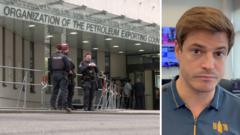
The United Arab Emirates (UAE) is quitting oil cartel Opec after nearly 60 years of membership.
Copyright current_year BBC. All rights reserved. The BBC is not responsible for the content of external sites. Read about our approach to external linking.
Copyright current_year BBC. All rights reserved. The BBC is not responsible for the content of external sites.
Read about our approach to external linking.
Split image showing the front of Opec building and Nick Marsh
Why has the UAE left Opec - and why does this matter?
The United Arab Emirates (UAE) has announced it is quitting Opec, the Organisation of Petroleum Exporting Countries, after nearly 60 years of membership.
Opec is an organisation of mainly Gulf oil exporters, which oversees oil production and has a major influence on the global prices.
The UAE's abrupt departure is seen as a blow to the group - and their exit could also affect you and your pocket.
More on this story: United Arab Emirates to quit oil cartel Opec
United Arab Emirates to quit oil cartel Opec
President Donald Trump said over the weekend that oil and gas prices "could be the same or maybe a little bit higher" in the coming months.
The BBC's Nick Marsh takes a look at whether fuel costs will get cheaper now the US and Iran have agreed a ceasefire.
The average price at the pump has topped $4 in the US for the first time since 2022 as the Iran war continues to push up fuel prices.
Drivers are queuing for hours at petrol stations in Myanmar as the Iran war continues to send shockwaves across the globe.
Paul Adams explains why it is so dangerous to navigate the strait, one of the world's busiest oil shipping channels.
BBC News Asia Business Correspondent Suranjana Tewari reports from a petrol station in Manila.
There were no injuries reported, the refinery operator Valero told the BBC's US news partner CBS.
Ten days since President Trump first announced the attack, people from across the US tell the BBC what they think the best outcome of the conflict could be.
Trade at the Middle East's biggest port has been hit hard since Iran's blockade of the Strait of Hormuz began.
The BBC spoke to New Yorkers about how the conflict in Iran is driving up prices at the pump - and how it's impacting their wallets.
The BBC's Nick Marsh examines how unrest in the Middle East will impact living costs around the world.
A timelapse of marine traffic shows the flow of ships has decreased in the Strait of Hormuz.
BBC Analysis Editor Ros Atkins examines allegations of links between the UAE and Sudan’s RSF in the civil war, as international efforts continue to seek an end to the fighting.
The BBC's Analysis Editor Ros Atkins examines President Trump's trip to the Gulf.
In the first major diplomatic trip during his second term, the president is hoping to secure significant new investment in the US in the four-day trip to Saudi Arabia, Qatar and UAE.
A Jackdaw gas platform under construction at a fabrication yard at Verdal near Trondheim.
The world champion slackliner crossed the 100m-long highline walk set up at a height of 224m between the towers.
At least one crew member was reportedly killed and footage showed an oil spill amid a heavy storm
Drivers near the city of Sharjah stopped their cars to watch the spiralling spectacle.
The BBC has found evidence that both the Sudanese army and RSF have used foreign drones in the war.
The US president says he saved eight Iranian women from execution, but Iran says otherwise.
The 300 couples were selected in a draw of nearly 2,000 people to be a part of the joint celebration.
The US and Iran's rival blockades of the Strait of Hormuz have become a "test of wills", says Lyse Doucet.
Analysis indicates that parts of the video appear to have been filmed hours after the ships were reportedly seized.
BBC Arabic's correspondent Carine Torbey reports from the border town of Khiam, as the ceasefire between Israel and Hezbollah in southern Lebanon goes into its second day.
Eyewitnesses captured the moment a burning fuel tanker drove through the centre of Hasakah, Syria, leaving a trail of fire behind it.
Lyse Doucet says Iranians want a solution to the long-running animosity with the US, but leaders is not willing to make a deal on Washington's terms.
While military targets have been struck in Iran, civilian areas have too, showing the stark reality of the war.
The BBC's chief international correspondent Lyse Doucet arrived in Tehran to what she described as 'life on pause'.
BBC foreign correspondent Nick Beake visits Metula, an Israeli town surrounded on three sides by Lebanon.
BBC Middle East correspondent Hugo Bachega joins paramedics on duty in Nabatieh - a city that was once vibrant, but is now abandoned.
BBC Middle East Correspondent Hugo Bachega hears from people affected by this week's attacks.
Pro-government demonstrators poured onto the streets of the Iranian capital after the announcement of the two-week conditional ceasefire between the US and Iran.
More than one million people in Lebanon have been displaced since the start of the war as Israel expands its ground operation there.
The BBC's Orla Guerin travels to the edge of the critical waterway that Iran has put a stranglehold on.
BBC reports from the funerals of three journalists killed by a targeted attack in southern Lebanon.
The BBC's Hugo Bachega speaks to families in Beirut as more than a million people have been displaced in Lebanon.
Violence began after a teenage settler was killed, reportedly after being hit by a vehicle driven by a Palestinian.
Israeli forces have been instructed to destroy the crossings over the Litani river that were being used by Hezbollah to send reinforcements.
The BBC's Sebastian Usher reports from Dimona in southern Israel, which was hit by an Iranian missile.