
World
Mali defence minister killed as country hit by wave of rebel attacks
April 27, 2026 International Source: BBC World



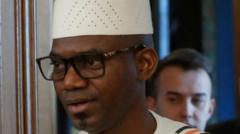
A wave of coordinated attacks by jihadist militants and separatists has spread through the country.
Mali Defence Minister Sadio Camara killed as country hit by rebel attacks
Gunshots ring out in Kati and gunmen seen on streets of Kidal
Copyright current_year BBC. All rights reserved. The BBC is not responsible for the content of external sites. Read about our approach to external linking.
Copyright current_year BBC. All rights reserved. The BBC is not responsible for the content of external sites.
Read about our approach to external linking.
Malian Foreign Minister Sadio Camara in Moscow in 2024
Mali defence minister killed as country hit by wave of rebel attacks
Camara (L), pictured with the Russian and Malian foreign ministers, is said to have died in a suicide truck bombing
Malian Defence Minister Sadio Camara, wearing traditional dress, is pictured with Russian Foreign Minister Sergey Lavrov (C) and Malian Foreign Minister Abdoulaye Diop (R), both wearing suits and ties at a meeting in Moscow.
Mali's defence minister has been killed in an apparent suicide truck bombing on his residence near the capital Bamako.
Multiple news outlets reported the death of Sadio Camara, part of a wave of coordinated attacks by jihadist militants and separatists carried out across the country.
Multiple news outlets reported the death of Sadio Camara, part of
by jihadist militants and separatists carried out across the country.
State TV confirmed the death several hours later, saying he died of wounds received while engaging with the attackers. Reports say the head of the military junta, Gen Assimi Goita, was moved to a safe location after his home was targeted.
State TV confirmed the death several hours later, saying he died of wounds received while engaging with the attackers.
Reports say the head of the military junta, Gen Assimi Goita, was moved to a safe location after his home was targeted.
Further north Russian mercenaries hired by Mali's military agreed to withdraw from Kidal after two days of clashes, the separatist Azawad Liberation Front (FLA) group said.
For years, Mali has been plagued by insurgencies by groups affiliated with al-Qaeda and the Islamic State group, and the FLA.
Quoting Camara's family and French media, news agencies said the attack - launched by militants affiliated with al-Qaeda in Kati on Saturday - also killed at least three of Camara's family members.
Government spokesman Issa Ousmane Coulibaly read out a statement on Sunday evening saying Camara was killed when "a vehicle laden with explosives and driven by a suicide attacker targeted the minister's residence".
It said he exchanged fire with the attackers and "succeeded in neutralising some of them". However, he was wounded and later died from his injuries in hospital.
The attack led to the collapse of Camara's residence and the destruction of a nearby mosque, where a number of worshippers were also killed.
Fighting on Saturday had been reported in the town, a major military base outside the capital, in Gao and Kidal in the north, and the central cities of Sevare and Mopti.
Reports suggest the assault by the separatists - who seek a breakaway ethnic Tuareg state in the north - was primarily focused on northern cities, while the jihadist group Jama'at Nusrat al-Islam wal-Muslimin (JNIM) had staged simultaneous attacks on multiple locations across the country.
Ulf Laessing, head of the Sahel programme at the Konrad Adenauer Foundation in Mali, told the BBC the incident appeared to be the "largest co-ordinated jihadist attack on Mali for years".
FLA spokesman Mohamed Elmaouloud Ramadane said Kidal had "not fallen completely" during those attacks, at the time, telling the BBC they remained in the city because "elements of the Malian army and Russian mercenaries" were still present.
On Sunday, clashes between the FLA and the Malian government resumed in Kidal.
Shortly after these reports, Ramadane said: "An agreement was reached between the Azawad forces and the Russian elements of the Africa Corps with a view to ensuring their secure withdrawal from the fighting."
In later updates, he said they were "permanently withdrawing from Kidal" and "Kidal is now free". There has been no confirmation of these claims from Mali's military.
Fighting between the FLA, Malian army and Russian mercenaries continued on Sunday
Grainy image of five fighters spaced out and standing in a sandy setting. There are structures in the background. In the foreground there is a crate of barrels.
The group also claims to have taken control of the city, which served as an unofficial headquarters of the separatist movement for more than a decade before it was captured by Mali's army with the help of Russian mercenaries in late 2023.
An FLA field commander involved in the assault on Kidal told the BBC on Saturday the group had been preparing for the offensive "for months", adding: "Our main goal now is to control Gao and then Timbuktu will be easy to fall."
State broadcaster ORTM reported that 16 people, including civilians and soldiers, were injured in the attacks, which it said caused "limited damage".
It also said several "terrorists" had been killed, adding that the situation is "completely under control" in all affected areas.
However, its military confirmed fighting was continuing in Kidal, as well as Kati and other parts of the country.
In a statement on Sunday, it said the violence would "not go unanswered".
It added that a nationwide alert had been issued, with large-scale patrols stepped up and checkpoints reinforced to tighten security.
Curfews have been imposed in some areas. In Bamako, there is a curfew from 21:00 to 06:00 local time (GMT), expected to end on Monday.
A map showing the locations of Bamako, Sevare, Mopti, Kidal and Gao in Mali, as well as neighbouring Burkina Faso, Niger, Algeria and Mauritania.
Following Saturday's widespread orchestrated attacks, UN chief Antonio Guterres condemned the "acts of violence" as he expressed his "solidarity with the Malian people". West Africa's regional bloc, Ecowas, similarly condemned the attacks.
Mali, Niger and Burkina Faso left Ecowas after military coups brought their armies to power.
Mahmoud Ali Youssouf, chair of the African Union Commission, said he was following the situation with "deep concern".
Splitscreen image. On the left, five unidentified people wearing army fatigues and on the right, a view of Kati from a rooftop.
The FLA has for years been fighting for the creation of its own Tuareg homeland in northern Mali, a large swathe of which it has effective control over.
Mali is currently ruled by a military junta led by Gen Assimi Goïta, who first seized power in a coup in 2020, promising to restore security and push back armed groups.
The junta had popular support when it took power, promising to deal with the long-running security crisis prompted by the Tuareg rebellion in the north, which was then hijacked by Islamist militants.
UN peacekeepers and French forces deployed to deal with the escalating insurgency left after the junta took over, and the military government hired Russian mercenaries to help tackle the insecurity.
However, the jihadist insurgency has continued and large parts of the north and east of the country remain outside government control.
JNIM fighters train in an undisclosed location in West Africa's Sahel region.
How an al-Qaeda offshoot became one of Africa's deadliest militant groups
A man covered with a Russian flag waves his arms and shouts as supporters of Niger's military leaders gather to demonstrate outside the Niger and French airbases in Niamey on August 27, 2023
Three West African juntas have turned to Russia. Now the US wants to engage them
Witnesses report clashes in the centre and north, in what has been described as the largest jihadist attack in years.
Growing insecurity in the Sahel made 2025 one of the worst years on record for the abduction of foreigners in Africa.
Insurgents have carried out a wave of drone strikes on military positions in the region.
The activist has condemned France's influence in West Africa and been accused of being a "Russian mouthpiece".
Several black Zambians tell the BBC they sometimes feel like they are second-class citizens in their own country.
A Ghanaian national was confronted by South Africans in a viral clip and questioned about his immigration status.
Piracy, once notorious in this stretch of the Indian Ocean, has made a comeback in recent years.
What court papers and sources close to the investigation have told the BBC about the scope of the plan.