
World
Artemis crew returning to Earth with 'all the good stuff' from Moon discoveries
April 9, 2026 International Source: BBC World



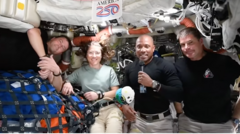
The four astronauts said they were returning to Earth with "so many more pictures, so many more stories".
Artemis II crew reflects on historic mission before splashdown on Friday
Watch: BBC asks Artemis II crew a question in space
Copyright current_year BBC. All rights reserved. The BBC is not responsible for the content of external sites. Read about our approach to external linking.
Copyright current_year BBC. All rights reserved. The BBC is not responsible for the content of external sites.
Read about our approach to external linking.
The four astronauts on Nasa's Artemis II mission smiling to camera while in a spacecraft with a floating toy gravity ball between them.
Artemis crew returning to Earth with 'all the good stuff' from Moon discoveries
Artemis II mission crew inside Orion capsule
The Artemis II crew said they have "many more pictures" and "many more stories" to share with the world as they prepare to return to Earth.
The four astronauts on board the Orion spacecraft have completed their mission around the Moon and are expected to splash down off the coast of San Diego on around 20:00 Friday US EDT (01:00BST).
Speaking to media from space on their way home, the mission's pilot, Victor Glover, said the crew was eager to share what they had seen with the world.
, the mission's pilot, Victor Glover, said the crew was eager to share what they had seen with the world.
When asked during Wednesday evening's conference, about re-entry to Earth, Glover said: "We have to get back. There's so much data that you've already seen, but all the good stuff is coming back with us."
"There's so many more pictures, so many more stories," he said.
Glover added that the crew still had "two more days" before they could begin to process what they'd been through.
"I'm going to be thinking about and talking about all of these things for the rest of my life," he said.
In pictures: Artemis II crew witness 'Earthset' and a solar eclipse
Artemis II: Inside Nasa's mission to take humans back to the Moon
First stop, the Moon. Next stop, Mars? Why Nasa's mission matters
The personal items the Artemis II crew are taking to the Moon
The Artemis II mission's spacecraft, Orion, broke the record for human travel at about 13:56 EDT (18:56 BST) on Monday, beating a record of 248,655 miles (400,000km) held since 1970 by the Apollo 13 mission.
The spacecraft was not planning to land on the Moon but fly around its far side, the side which is never visible from Earth. Satellites have photographed the far side before, but the astronauts were the first human eyes to see some parts of the far side's surface and its vast craters and lava plains.
The spacecraft was not planning to land on the Moon but
, the side which is never visible from Earth. Satellites have photographed the far side before, but the astronauts were the first human eyes to see some parts of the far side's surface and its vast craters and lava plains.
Straight after the flyby, President Trump spoke with the Orion team and congratulated them: "Today, you've made history and made all America really proud, incredibly proud."
During the most recent virtual news conference, at Nasa's Johnson Space Center in Houston, the four astronauts once again beamed into a live stream as a microphone floated between them.
They each took turns answering questions from reporters with considerable delays.
The crew was asked by the Los Angeles Times about the 40 minutes of "profound solitude" when they lost contact with Earth.
Commander Reid Wiseman said the crew had a lot of scientific work to do and it was "probably the most critical lunar observations for our geology team".
"But the four of us took a moment, we shared maple cookies that Jeremy had brought, and we took about three or four minutes, just as a crew to really reflect on where we were," he said.
For Glover, the "greatest gift" of the mission was seeing the lunar eclipse from beyond the far side of the moon.
For Wiseman, the "pinnacle moment" was when his team named a lunar crater after Wiseman's late wife, Carroll, who died of cancer in 2020.
"I think when Jeremy spelled Carroll's name .... I think for me that is when I was overwhelmed with emotion and I looked over and Christina was crying," Reid said.
"Just for me personally, that was kind of the pinnacle moment of the mission for me," he continued.
The crew also said they were getting their source of news from planet Earth from their family members.
They have "been our source of how the mission is going from the public perspective," Wiseman said, before adding "obviously they're all biased".
When asked by BBC's News Science Editor Rebecca Morelle what the crew will miss most about being space, Christina Koch said she will miss the "camaraderie".
On what she won't miss, Koch said there wasn't anything.
"We can't explore deeper unless we are doing a few things that are inconvenient, unless we're making a few sacrifices, unless we're taking a few risks. And those things are all worth it," she said.
The crew now face several quieter days of checks and experiments before a final ordeal: a fiery plunge through the atmosphere at nearly 25,000mph and a parachute splashdown into the Pacific that will test the capsule's heatshield and recovery systems.
(From left) Jeremy Hansen, Reid Wiseman, Christina Koch and Victor Glover conduct a live broadcast from space
Artemis II crew head for home after travelling further from Earth than anyone before
Rocket taking off with bright blue sky behind it.
Has Artemis II shown we can land on the Moon again?
Everything you need to know about Nasa's Artemis II mission
Engineers are building Lunar Pathfinder - a spacecraft to cut Moon mission communications blackouts.
Astronauts in space have been jamming to Chappell Roan's Pink Pony Club, but how does it all happen?
The Oxford band joke a vial they lost in 2024 in the space capsule caused the toilet malfunctions.
Last year, the Welsh space sector contributed £345m to the economy.
The Artemis crew will return to Earth on 10 April after a 10-day mission that took them around the Moon.
The Orion spacecraft is scheduled to bring the Artemis II crew back to Earth on 10 April.
The Orion spacecraft is expected to splash down off the coast of San Diego on 10 April.
Jeremy Hansen received a call from the prime minister as Canada's first astronaut to travel into deep space as part of the Artemis II mission.