
World
Trump says Iran's handling of Strait of Hormuz is 'not the agreement we have'
April 10, 2026 International Source: BBC World



The US president accused Iran of "doing a very poor job" with the waterway as Israel and Lebanon to begin peace talks.
Trump says Iran's handling of Strait of Hormuz is 'not the agreement we have'
Copyright current_year BBC. All rights reserved. The BBC is not responsible for the content of external sites. Read about our approach to external linking.
Copyright current_year BBC. All rights reserved. The BBC is not responsible for the content of external sites.
Read about our approach to external linking.
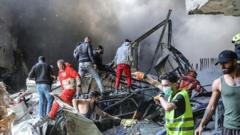
Israel launched a blitz of air strikes on Lebanon on Wednesday, hitting over 100 targets in 10 minutes
US President Donald Trump has accused Iran of doing a "very poor job" in its handling of oil passing through the pivotal Strait of Hormuz, arguing it was "not the agreement we have".
The comments reflect the fragile nature of the ceasefire agreement, with reports showing conflicts on what was included in the accord.
It came as Israeli Prime Minister Benjamin Netanyahu said his government was to begin direct talks with Lebanon, focusing on the disarmament of Hezbollah, the Iran-backed militant group, and establishing peaceful relations.
A US State Department official confirmed it would host a meeting next week in Washington "to discuss ongoing ceasefire negotiations with Israel and Lebanon".
Lebanese officials had called for a ceasefire before the talks begin, but Netanyahu said in a subsequent address to residents of northern Israel: "There is no ceasefire in Lebanon."
After Israeli strikes continued in Lebanon throughout Thursday - targeting what it described as Hezbollah rocket launch sites in the south - attacks appeared to at least temporarily taper off overnight in the region.
After Israeli strikes continued in Lebanon throughout Thursday - targeting what it described as Hezbollah rocket launch sites in the south -
attacks appeared to at least temporarily
Trump said in an interview that Israel would be "scaling back" its strikes in the country to support peace talks.
"I spoke with Bibi and he's going to low-key it. I just think we have to be sort of a little more low-key," Trump told NBC News after a phone call with Netanyahu.
The strikes on Thursday led to new evacuation warnings for residents in the southern suburbs of the capital, Beirut.
The head of the World Health Organization (WHO), Tedros Adhanom Ghebreyesus, said on X that this included the Jnah area, which includes two major hospitals.
"At this time, no alternative medical facilities are available to receive approximately 450 patients from the two hospitals (including 40 patients in the ICU), rendering their evacuation operationally unfeasible," he said.
Among those being treated at the hospitals, Tedros added, were some of the 1,150 people that Lebanon's health ministry said were wounded in Wednesday's massive wave of Israeli strikes. At least 303 people were killed.
Tedros also said that the headquarters of the Ministry of Public Health, which "hosts five shelters accommodating more than 5,000 people", is in the evacuation area.
That ceasefire began with confusion over whether Lebanon, Israel's second front, was to be included. Iranian officials and mediators from Pakistan said it was, US and Israeli officials said clearly that it was not.
Amid the confusion, the wave of Israeli strikes on Lebanon – the heaviest since the conflict began six weeks ago – prompted Iran to declare that Israel was breaking the terms of the ceasefire, to once again halt passage of shipping through the Strait of Hormuz, and to threaten retaliatory strikes.
Amid the confusion, the wave of Israeli strikes on Lebanon – the heaviest since the conflict began six weeks ago – prompted
Iran to declare that Israel was breaking the terms of the ceasefire
, to once again halt passage of shipping through the Strait of Hormuz, and to threaten retaliatory strikes.
Trump posted to Truth Social over ship traffic through the pivotal waterway, which typically sees 20% of the world's oil and liquefied natural gas (LNG) passing through.
"There are reports that Iran is charging fees to tankers going through the Hormuz Strait," he wrote. "They better not be and, if they are, they better stop now."
Israel's military continues to occupy a large part of the south of Lebanon, where it has destroyed villages in recent days. Without a commitment to a temporary ceasefire at least, it is not clear how productive talks could proceed between the two sides.
It is also unclear how much sway the Lebanese government, with which the Israelis will be negotiating, will have over Hezbollah, which despite having representation in the Lebanese government is a separate entity backed by Iran.
The Lebanese government banned Hezbollah's military activities in early March, days after the start of war with Israel, but it has not stopped the group from carrying out military operations.
A Lebanese army soldier stands next to a destroyed residential building the day after an Israeli airstrike in the Ain Mreisseh neighbourhood of Beirut
Lebanon thought there was a ceasefire - then Israel unleashed deadly blitz
Hugo Bachega indicating towards rubble in Beirut after air strikes
BBC at the site of Israeli air strikes in Beirut
An Iranian resident looks out the window of his damaged home after Israeli-American strikes that according to local media reports destroyed the Rafi-Nia Synagogue and nearby residential buildings in Tehran, on April 7 2026.
Bowen: Ceasefire means respite for civilians, but it might not last long
Map of areas reported to have been struck by Israel since 8 April
On Thursday, Lebanon's cabinet instructed government security forces to restrict weapons in Beirut exclusively to state institutions.
"The army and security forces are requested to immediately begin reinforcing the full imposition of state authority over Beirut Governorate," Prime Minister Nawaf Salam said at the end of a cabinet meeting.
Netanyahu's office said Israel "appreciates today's call by the Prime Minister of Lebanon to demilitarise Beirut".
It said negotiations between the two countries would focus on "disarming Hezbollah and establishing peace relations between Israel and Lebanon".
According to US outlet Axios, Netanyahu's statement came after he held calls with US President Donald Trump and White House envoy Steve Witkoff.
The publication quoted a senior Israeli official who said the direct negotiations will begin next week in Washington.
Lebanese President Joseph Aoun earlier said that a ceasefire was "the only solution" to the situation in Lebanon.
Aoun had called for direct negotiations with Israel a month ago as part of a proposal to end the escalating conflict with Hezbollah, while sharply criticising the Iran-backed group.
called for direct negotiations with Israel
a month ago as part of a proposal to end the escalating conflict with Hezbollah, while sharply criticising the Iran-backed group.
The latest escalation in the decades-long conflict between Hezbollah and Israel erupted when the group fired rockets into Israel in retaliation for the killing of Iran's supreme leader Ayatollah Ali Khamenei in the opening stages of the war, and in response to the near-daily Israeli attacks on Lebanon that have continued despite a ceasefire agreed in November 2024.
More than 1,800 people have been killed, including at least 130 children, so far as a result of the war, the Lebanese health ministry says, without distinguishing combatants from civilians.
Israel says it has killed around 1,100 Hezbollah fighters.
More than 1.2 million people have been displaced, or one in five of the population, most of them from Shia Muslim communities.
Head and shoulders pic of Pete Hegseth at the podium of the Pentagon briefing room. He's wearing a well-tailored petrol blue suit with a blue and pink tie on a white shirt. His left hand is raised and his thumb and index finger joined as if emphasising a point
Has US achieved its war objectives in Iran?
A number of rescue workers, some with helmets and head torches, others with face masks, work in the rubble of a destroyed building
Negotiators face huge task to close gaps in rival Iran peace proposals
Saeed Khatibzadeh pictured at a press conference in Tehran in 2022
Israeli strikes in Lebanon 'grave violation' of ceasefire, Iran minister tells BBC
A woman with her child stands behind police tape next to rubble and debris on a street and looks at the aftermath of an Israeli and the U.S. strike on a police station, 2 March 2026.
'Endless fears': Even if fighting stops, the damage to Iran's children will endure
An Iranian woman wears a black hijab and chador and has a national flag draped over her shoulders as government supporters gather at Enghelab Square following the US-Iran ceasefire announcement, in Tehran, Iran (8 April 2026)
Why ceasefire deal with US has unsettled Iran's hardliners
Peace talks between the US and Iran are due to begin in Pakistan on Saturday.
Only a few vessels have crossed the strait since the US-Iran ceasefire deal, according to BBC Verify analysis.
Both sides have reason to end the war but share no common ground.
A senior Lebanese official earlier told the BBC that Lebanon would only take part in talks if a ceasefire was in place.
The killing came as ex-security chiefs warned "government sponsored Jewish terrorism" was out of control.
Iran's deputy foreign minister says the US must choose between 'war and ceasefire'.
The Israeli military claims Mohammed Wishah was a "Hamas terrorist" - which the Qatar-based network has previously denied.
The Israeli prime minister's response to the ceasefire has been muted, in contrast to the triumphal statements from the US and Iran.