
World
Lebanon thought there was a ceasefire - then Israel unleashed deadly blitz
April 9, 2026 International Source: BBC World



Israel says Lebanon is not included in the ceasefire the US agreed to halt the war with Iran.
Lebanon thought there was a ceasefire - then Israel unleashed deadly blitz
Israel says it hit Lebanon 100 times in just 10 minutes
BBC at the site of Israeli air strikes in Beirut
Copyright current_year BBC. All rights reserved. The BBC is not responsible for the content of external sites. Read about our approach to external linking.
Copyright current_year BBC. All rights reserved. The BBC is not responsible for the content of external sites.
Read about our approach to external linking.
Israel's attacks took the country by surprise on Wednesday
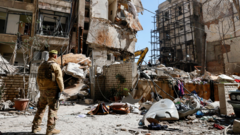
A Lebanese army soldier stands next to a destroyed residential building the day after an Israeli airstrike in the Ain Mreisseh neighbourhood of Beirut
The guns were supposed to have fallen silent.
It was, after all, just hours after US President Donald Trump had announced that a two-week ceasefire had been agreed to halt the war in the Middle East.
But just as the region was breathing a sigh of relief, Israeli jets conducted a 10-minute blitz across Lebanon - a massive aerial attack that killed at least 303 people and wounded 1,150 others, according to Lebanon's health ministry.
Local and Western condemnation was swift and widespread, but no criticism came from the US against its ally in this war.
Iran said this was "a blatant violation" of the ceasefire deal and has asked the US to halt the Israeli "aggression".
Lebanese officials say more than 1,700 people have been killed since Israel launched its latest campaign in Lebanon last month. Israel has said its operations are aimed at weakening Hezbollah and achieving what it calls remaining military objectives.
The war began with US and Israeli strikes on Iran on 28 February - prompting retaliation from Tehran against US allies in the Gulf, and from Iran's proxies - Hezbollah in Lebanon and the Houthis in Yemen - against Israel.
In response, Israel began striking Hezbollah and even ordered its troops to occupy large parts of Lebanon.
What we know about the two-week ceasefire between the US and Iran
How Pakistan helped secure a fragile ceasefire between the US and Iran
Israel carries out large wave of air strikes across Lebanon
Graphic with Verify branding, and an image of smoke plume following a strike
The two-week pause in the fighting was announced by Pakistan's Prime Minister Shehbaz Sharif - who has been serving as mediator between the warring parties. Sharif said the US and its allies "have agreed to an immediate ceasefire everywhere including Lebanon and elsewhere".
But the main adversaries of Iran do not appear to share this understanding. The government of Israeli Prime Minister Benjamin Netanyahu said the ceasefire did not include Lebanon and Donald Trump signalled his agreement by stating the war in Lebanon was "a separate skirmish".
Map of areas reported to have been struck by Israel since 8 April
Wednesday, 8 April. It was around 14:00 in Beirut (11:00 GMT) when the skies over Lebanon darkened.
The Israel Defense Forces (IDF) said that within 10 minutes it had "completed the largest co-ordinated strike across Lebanon since the start of Operation Roaring Lion" - the code name for the Israeli operation against Iran.
It said it had targeted "100+ Hezbollah headquarters, military arrays, & command-and-control centres in Beirut, Bekaa and southern Lebanon".
Densely populated parts of central Beirut were hit in strikes described by officials as among the heaviest since Hezbollah joined the conflict in early March.
And it was not just the traditional Hezbollah stronghold of Dahieh that was hit in the Lebanese capital - the city centre was also hit.
Safa Bleik, a registered nurse and coordinator for international medical charity Médecins Sans Frontières (MSF), happened to be inside the Rafik Hariri Hospital in Beirut as the attacks unfolded.
"The first patients came in with severe head injuries, with fragments of glass, metal and debris lodged in their bodies. Many were unconscious. Some died shortly after arrival," she said.
"Soon, the emergency room filled with people searching," Bleik said. "I was trying to stop the bleeding of a man who had arrived with severe head trauma and shrapnel in his abdomen, when a young man came up to me holding a phone, showing me a photo of his brother. He was asking if I had seen him."
Casualties were reported in the Bekaa Valley, in the east, and in the southern Nabatieh, Sidon and Tyre regions.
Hezbollah may have been taken by surprise - their only response appeared to have been a few rockets fired towards Israel hours later.
On Thursday, Israel continued its attacks, saying it had killed "70+ terrorists". It denies targeting civilians. The IDF also said Hezbollah had fired some 30 rockets at northern Israel, with no reports of injuries or damage.
The IDF also said it had "ELIMINATED: Ali Yusuf Harshi, the personal secretary to Hezbollah Secretary-General Naim Qassem in Beirut".
There has been no confirmation. The BBC is unable to verify the claims.
On a crisp and sunny Thursday morning, there was a heaviness in the air in Beirut. Usually the streets are buzzing with traffic but the country has been observing a day of national mourning. President Joseph Aoun described it as a "massacre".
At some locations search and recovery operations have been continuing.
There is nothing left of the 10-storey residential building that was attacked in Tallet el Khayat, a well-to-do neighbourhood of western Beirut, one of the many locations hit. The air strike happened without warning and would have caught everyone by surprise, as this was not an area that had been targeted in the past.
Civil defence teams have been combing through buildings here and across the country, but there is little hope for people who still have loved ones missing.
Ziad Samir Itani, who was leading the civil defence team, said rescuers were exhausted after more than six weeks of constant attacks by Israel.
Benjamin Netanyahu said on Thursday Israel would continue to strike Hezbollah "wherever necessary, until we restore full security to the residents of the north".
It is difficult to see what the long-term Israeli strategy is. Even Israeli military officials acknowledge what has been known in Lebanon for a long time: that Hezbollah will not be disarmed by force. The attacks may give Israel some military gain, but this is likely to be limited.
In Lebanon, opponents and supporters of Hezbollah are coming together in anger, united in the view that what happened here was unacceptable and unjustifiable.
Iran's President Masoud Pezeshkian denounced the "blatant violations" by Israel, which, he added may render negotiations "meaningless".
An Iranian resident looks out the window of his damaged home after Israeli-American strikes that according to local media reports destroyed the Rafi-Nia Synagogue and nearby residential buildings in Tehran, on April 7 2026.
Bowen: Ceasefire means respite for civilians, but it might not last long
A headshot-style crop shows Trump looking pensively to the right of frame against a backdrop of the stars of the American flag and a plaque picturing the White House, while speaking during a press conference in Washington DC on Monday.
Iran ceasefire deal gives Trump a way out of war - but at a high cost
Peace talks between the US and Iran are due to begin in Pakistan on Saturday.
Only a few vessels have crossed the strait since the US-Iran ceasefire deal, according to BBC Verify analysis.
The US president accused Iran of "doing a very poor job" with the waterway as Israel and Lebanon to begin peace talks.
Tanker firms are being advised not to pay Iran any levies in return for safe passage through the Strait of Hormuz.
Lebanon will only take part in talks with Israel if a ceasefire is already in place, a senior official tells the BBC.
The trade body for European airports said if the Strait of Hormuz did not open in the next three weeks, there could be shortages.
Critical minerals, cryptocurrency, and CIA co-operation - how Asim Munir, Trump’s “favourite field marshal”, may have pulled off the diplomatic coup of the century.
UK petrol prices have risen because of the US-Israel war with Iran but the ceasefire could see prices drop.