
World
US blockade of Iran ports irresponsible and dangerous, China says
April 14, 2026 International Source: BBC World



China, the biggest buyer of Iranian oil, says the US naval blockade undermines an "already fragile ceasefire".
US blockade of Iran ports 'irresponsible and dangerous', China says
Copyright current_year BBC. All rights reserved. The BBC is not responsible for the content of external sites. Read about our approach to external linking.
Copyright current_year BBC. All rights reserved. The BBC is not responsible for the content of external sites.
Read about our approach to external linking.
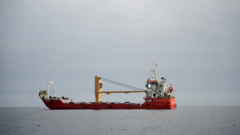
A vessel in the Strait of Hormuz, off the coast of Oman’s Musandam province, on 12 April
US blockade of Iran ports irresponsible and dangerous, China says
China has called the US naval blockade of Iranian ports "irresponsible and dangerous".
Beijing's foreign ministry said the move would "undermine the already fragile ceasefire agreement" and further jeopardise the safety of ships passing through the Strait of Hormuz, a critical waterway Iran effectively closed in response to US-Israeli strikes.
The blockade came into force on Monday, a day after peace talks between the US and Iran broke down in Pakistan.
US President Donald Trump has said the measure is intended to force Iran to give up its nuclear ambitions. Analysts say the move is also designed to pressure China - the biggest buyer of Iranian oil - to encourage Tehran to open the strait.
Map titled “US blockade of Iran’s Gulf coast” showing Iran’s southern coastline along the Persian Gulf, Strait of Hormuz and Gulf of Oman highlighted in red to indicate a blockade. Iranian territorial waters are shaded, with a caption stating “US blockade will affect all ships travelling to or from Iran’s Gulf coast” Ports and major jetties are marked with purple dots, including Kharg Island and Bandar Abbas. Surrounding seas are labeled, including the Arabian Sea, and a distance scale, source credit, and BBC logo are visible.
Iran's ambassador to the UN has described the US blockade as a "grave violation" of Tehran's sovereignty.
Up until now, Chinese vessels have been among the few managing to make their way through the strait. It is not clear whether they had to pay a toll to Iran in order to do so.
The US blockade could potentially cut off China's supply and have far-reaching consequences for its economy.
US-sanctioned ships pass Strait of Hormuz as China calls Trump's blockade 'dangerous'
"China believes that only by achieving a comprehensive ceasefire and ending the war can we fundamentally create conditions for easing the situation in the strait," China's foreign ministry spokesman Guo Jiakun said.
"China urges all parties to abide by the ceasefire arrangements, focus on the general direction of dialogue and peace talks, take practical actions to promote the easing of the regional situation, and restore normal traffic in the strait as soon as possible."
Guo also told a news conference on Tuesday that reports China was preparing to deliver new air defence systems to Iran were "completely fabricated".
Trump has threatened to impose a 50% tariff on China's goods if military assistance was provided to Tehran.
"If the US insists on using this as an excuse to impose additional tariffs on China, China will definitely take resolute countermeasures," Guo said.
It comes after US Vice-President JD Vance accused Iran of "economic terrorism" over its own blockade of the Strait of Hormuz - having attacked, and threatened to attack, vessels passing through since last month.
"Well, as the president of the United States showed, two can play at that game," he told Fox News.
"If the Iranians are going to try to engage in economic terrorism, we're going to abide by the simple principle that no Iranian ships are getting out, either."
The US has said its military would not impede ships using the strait to go to and from non-Iranian ports.
It is instead aiming to blockade Iran's Gulf ports by operating its navy in the Gulf of Oman and the Indian Ocean, rather than risk its vessels close to Iran's coast.
But shipping data analysed by BBC Verify shows that at least four Iran-linked ships crossed the strait on Tuesday.
But shipping data analysed by BBC Verify
shows that at least four Iran-linked ships crossed the strait on Tuesday.
Meanwhile, oil prices fell back below $100 per barrel on Tuesday.
A delicate and fragile ceasefire between the US and Iran remains in place, having been implemented on 8 April.
Major points of contention between the two sides include the status of the Strait of Hormuz, and whether Lebanon is included in the agreement.
Israel maintains that the truce applies only to Iran and has continued heavy strikes against Hezbollah, killing hundreds. Direct talks between Lebanese and Israeli officials are set to be held in the US later - the first such negotiations in decades.
The United Nations' secretary general said it was "highly probable" that the negotiations would restart.
A US statement said the two sides had agreed to launch direct negotiations, at a time and place to be determined.
Four vessels with links to Iran have crossed the Strait of Hormuz despite the start of a US naval blockade, but two of those vessels appear to have reversed course.
Veteran leader Nitish Kumar, who moved to the upper house of parliament, resigned as chief minister on Tuesday.
A subdued economy makes trade-offs and choices over public spending more difficult, Chris Mason writes.
The White House is considering a bid for the late MP to receive America's highest civilian honour.
Johnny Somali sparked outrage after kissing a statue representing World War Two sex slaves.
The Trump administration is asking a court to throw out the convictions of Stewart Rhodes and other members of the Oath Keepers and Proud Boys.